
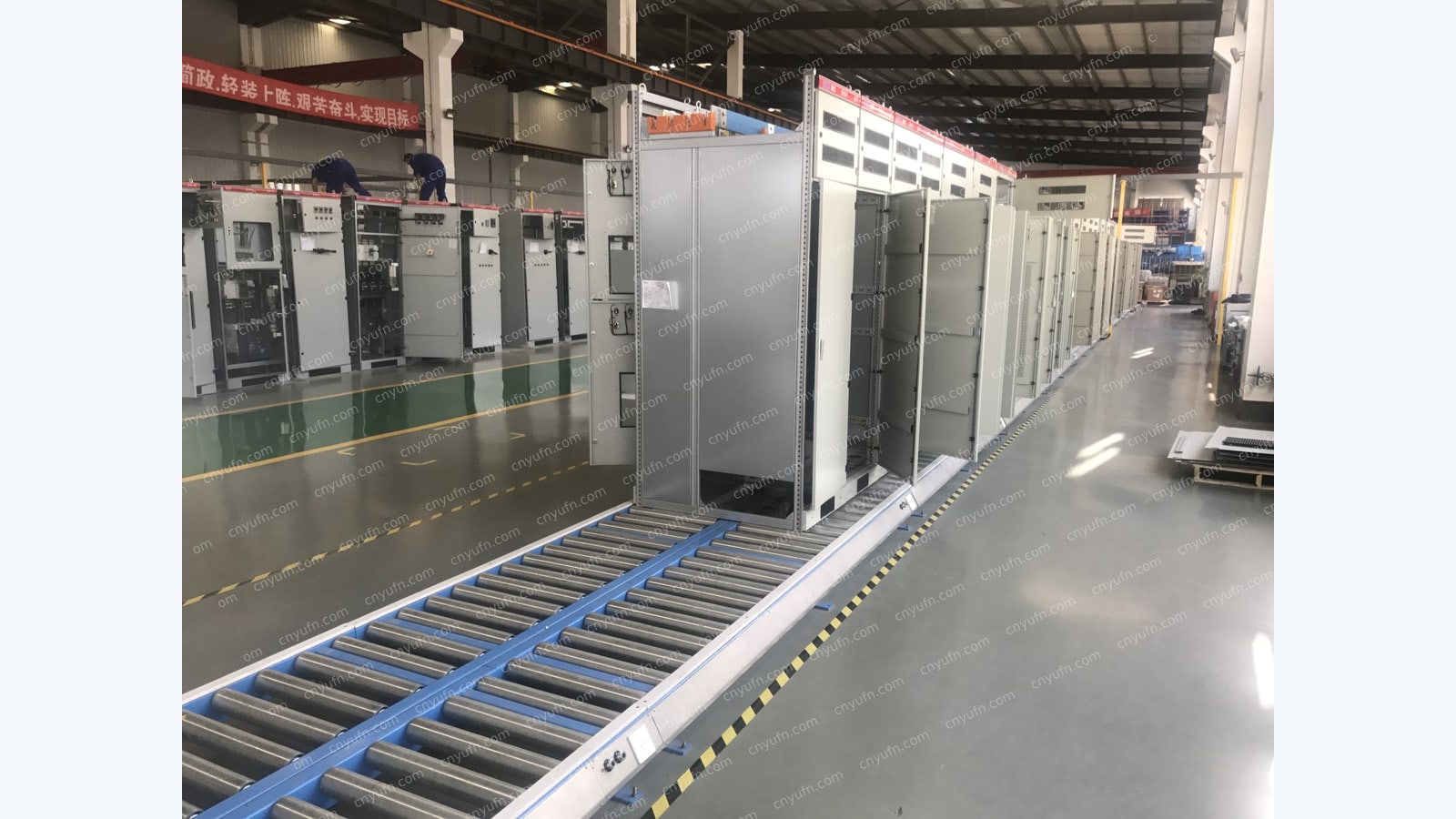
Low voltage switchgear production is an assembly-intensive process. Cabinet body assembly, busbar machining, component mounting, secondary wiring and factory testing involve many steps and many materials. Without a unified production organization, late delivery, missing and wrong parts, and difficult quality traceability become common problems. The low voltage cabinet final assembly line planned by Taizhou Yufeng Intelligent Equipment Co., Ltd. puts station-based work, clear cycle time and mistake-proofing at the center, turning complex assembly into an orderly and controllable process.
Dividing the final assembly line into stations
A low voltage cabinet final assembly line is usually divided into a cabinet body assembly station, a busbar installation station, a primary component mounting station, a secondary wiring station, a final inspection and commissioning station, and a packing station. Products move along roller conveyors or pallet conveyors at a fixed cycle, and each station completes only a fixed scope of work with work instructions posted at the station. For cabinets of different sizes, the conveyor width is adjustable and the pallets use universal locating structures to reduce changeover time.
Busbar machining and installation
The busbar is the backbone of the low voltage cabinet conductive circuit. We configure busbar bending, punching and straightening equipment in the line to process bars centrally according to drawings, reducing on-site cutting. The busbar installation station uses torque wrenches to tighten connection bolts to standard torque and pastes anti-loosening marks. The connection surfaces require removal of the oxide layer and application of conductive paste to ensure reliable connection. After installation, loop resistance or temperature rise sampling verifies the conductive performance.
Standardized secondary wiring
Secondary wiring is the step with the most variation in low voltage cabinet production. We divide the secondary wiring station into cable harness prefabrication, routing, termination and inspection. Wire number tubes, terminal blocks and cable ducts follow the drawings. The inspection step checks the terminal number and wire gauge of every wire to prevent wrong connections. After wiring, a power-on check verifies the function of auxiliary circuits.
Final commissioning and factory testing
The commissioning station performs mechanical operation, electrical operation, interlock function, protection parameter setting and insulation testing. Factory testing follows national standards or customer requirements, including power frequency withstand voltage, insulation resistance, function verification and visual inspection. Test data is recorded automatically and a factory report is generated and stored under the product number.
Applicability to switchgear manufacturers
This final assembly line suits both highly standardized low voltage cabinets and mixed LV/HV cabinet production. For switchgear companies with many product variants and small batch sizes, we recommend flexible stations with lean logistics, stabilizing the cycle of standard cabinets first and then expanding to non-standard products. The line can later add automatic busbar processing and automatic cable harness prefabrication equipment to improve efficiency continuously.
To plan a low voltage switchgear final assembly line, contact Taizhou Yufeng Intelligent Equipment Co., Ltd. We will provide a complete solution based on your cabinet list, output and factory conditions.