
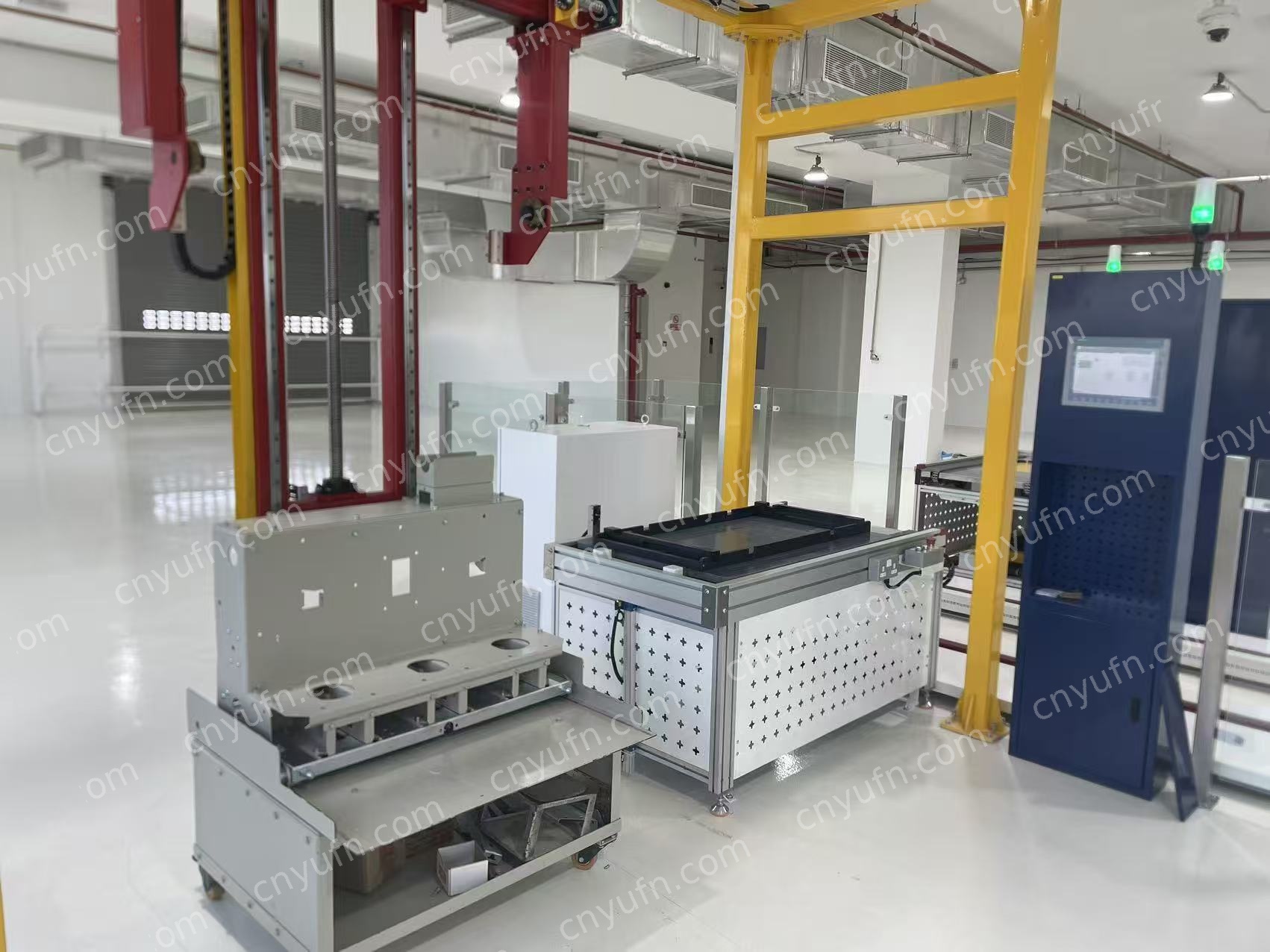
After a VCB mechanism is fully assembled, it must run through a running-in phase to verify the stability of mechanism action and wear trends. During running-in, the mechanism opens and closes repeatedly, which generates noise and heat. If this is done directly in the assembly area, it pollutes the working environment and occupies assembly space. Taizhou Yufeng Intelligent Equipment Co., Ltd. integrates a dedicated running-in test room and a lifting off-loading machine into the VCB assembly workflow, forming a smooth closed loop of assembly, running-in and off-loading.
Design points of the running-in test room
The running-in test room first solves the noise problem. The room uses sound-absorbing materials and sound-insulating structures to keep the impact noise of mechanism opening and closing under control and maintain a proper workshop environment. Inside the room, multiple running-in stations are configured. Each station can run several breakers at the same time, automatically completing the set number of opening and closing cycles, and recording the number of actions, action time and abnormal signals. A buffer zone is set between the running-in room and the assembly area. Assembled products are automatically fed into the room and automatically output after running-in, avoiding waiting.
Integrating the lifting off-loading machine
VCB products are large and heavy, and manual lifting in the off-loading step is inefficient and risky. We integrate a lifting off-loading machine at the end of the line to move qualified products automatically from the conveyor to the packing area or the test bench. The machine uses an electric hoist or gantry structure with anti-sway and positioning devices, so the operator only needs one-button control. For products that still need withstand voltage testing, the off-loading machine can transfer them directly to the test station, reducing intermediate handling.
Flow connection between assembly, running-in and off-loading
The whole flow is arranged in the order of assembly stations, running-in room, test benches and off-loading station, so materials flow in one direction without crossing or returning. The assembly area uses visual management boards, and the running-in room is scheduled automatically according to assembly output. Each product carries a unique number, and the running-in data and test data are bound to the same number, forming a traceable record from assembly to shipment.
Data and quality management
The running-in system automatically counts the number of opening and closing cycles, abnormal events and recovery status for each product. For problems found during running-in, the system creates a rework order and returns the product to the relevant station. Quality staff can review reports to check the consistency of running-in among a batch and judge the quality stability of mechanism suppliers, supporting purchasing decisions with data.
Value to customers
This integrated approach lets VCB production stop depending on manual memory and field experience. The cycle is clear, the environment is clean and the data is complete. It improves internal efficiency and makes it easy to demonstrate a standardized manufacturing process during customer factory audits. For export projects, the running-in records and test reports can be part of the delivery documentation.
To evaluate a VCB running-in room and off-loading solution, send us the breaker model, daily output, required number of running-in cycles and factory layout.