
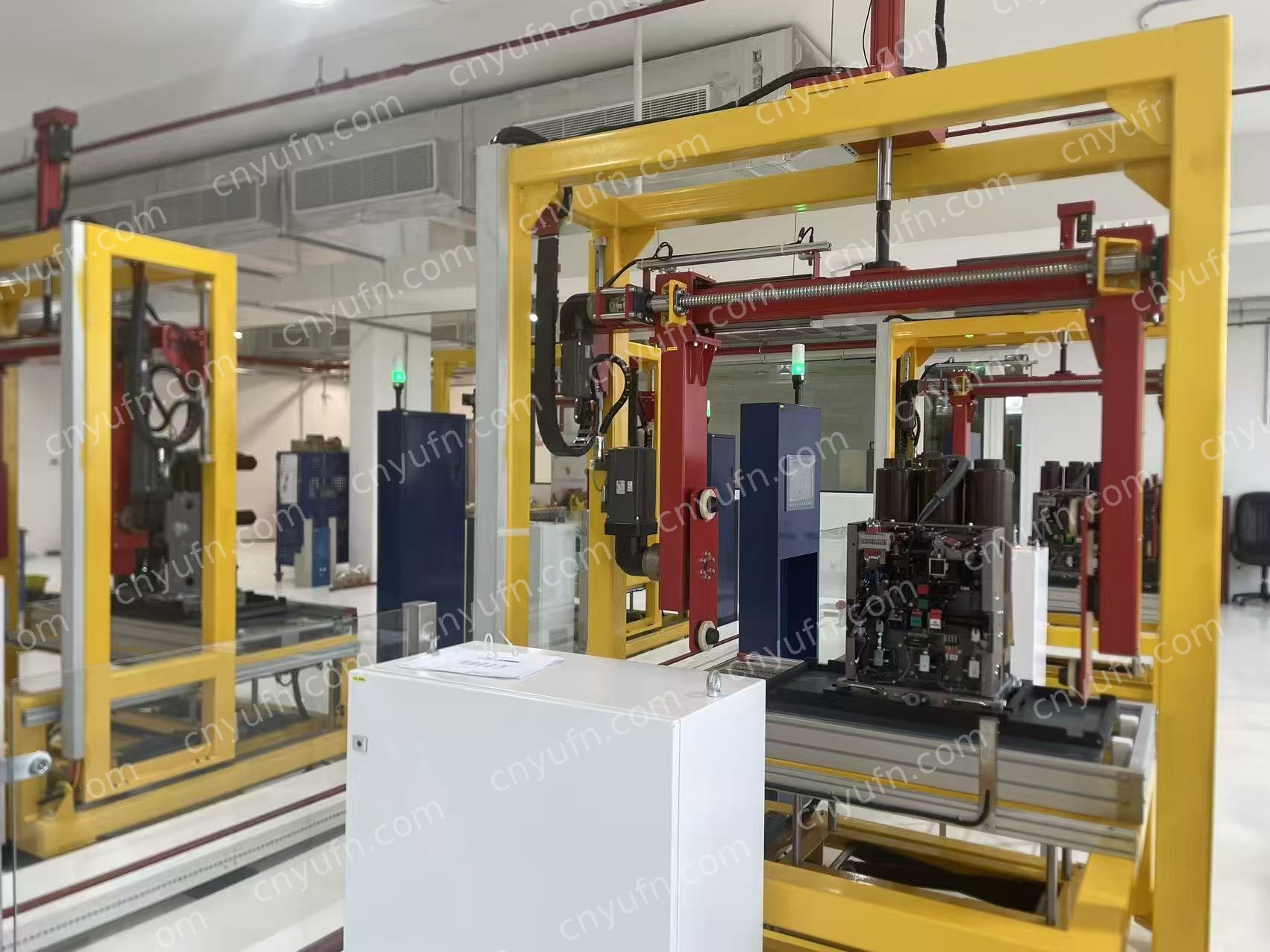
The contact arms and contacts are important parts of the vacuum circuit breaker conductive circuit. They directly affect current-carrying capacity and contact reliability. Contact arm assembly looks simple, but it involves bending the conductive copper bars, pressing the contacts, and controlling the torque of springs and fasteners. A problem at any point affects contact resistance and temperature rise. Taizhou Yufeng Intelligent Equipment Co., Ltd. planned a contact arm and final assembly line for switchgear manufacturers, standardizing these fine assembly details.
Contact arm assembly station design
The contact arm assembly station is equipped with dedicated locating fixtures to assemble the contact arm, contacts, springs and fasteners in order. The pressing process uses pneumatic press equipment with settable and recordable pressure parameters, ensuring consistent pressing quality for every contact. The fastening process uses digital torque wrenches to tighten to the torque value specified in the process, eliminating missing and over-tightened fasteners. Assembled contact arms are measured for contact resistance and dimensions on dedicated inspection fixtures, and only qualified parts flow to the final assembly area.
Conductive circuit connection control
In the final assembly stage, the three-phase contact arms, mechanism, insulating parts and conductive connections are assembled into a complete circuit. The contact surfaces of conductive connections must be clean and the torque correct to avoid local heating from poor contact. We recommend torque monitoring and torque mistake-proofing at the final assembly station, confirming and recording each critical connection point. Loop resistance measurement can be used as a comprehensive verification of assembly quality, and abnormalities are repaired promptly.
Final assembly and machine commissioning
The final assembly line is organized in the order of mechanism pre-assembly, contact arm installation, three-phase poles, electrical connection and machine commissioning. The commissioning station performs manual opening and closing checks, electric operation verification, preliminary mechanical characteristic testing and auxiliary circuit inspection. Problems found during commissioning are handled directly at the station to prevent non-conforming products from flowing into final inspection. Commissioning data and assembly records are bound to the product number, forming a complete file.
Mistake-proofing and traceability
Key processes on the line are equipped with mistake-proofing devices. For example, the next step cannot proceed if the torque wrench has not reached the set torque, and the equipment alarms when pressing pressure is out of range. Every product has a unique routing card or QR code, and scanning records the completion status, operator and inspection result of each process, achieving full traceability.
Line planning advice
For VCB assembly needs within about 30 units per day, a solution of manual stations plus auxiliary inspection equipment is suitable, with moderate investment and flexible adjustment. For high-volume production, automation can be introduced in repetitive processes such as contact pressing and circuit testing. The specific plan needs to be evaluated based on the product structure and output.
For VCB contact arm and final assembly line projects, send us the product drawings, process requirements, output and factory details. We can provide station proposals and equipment quotations.