
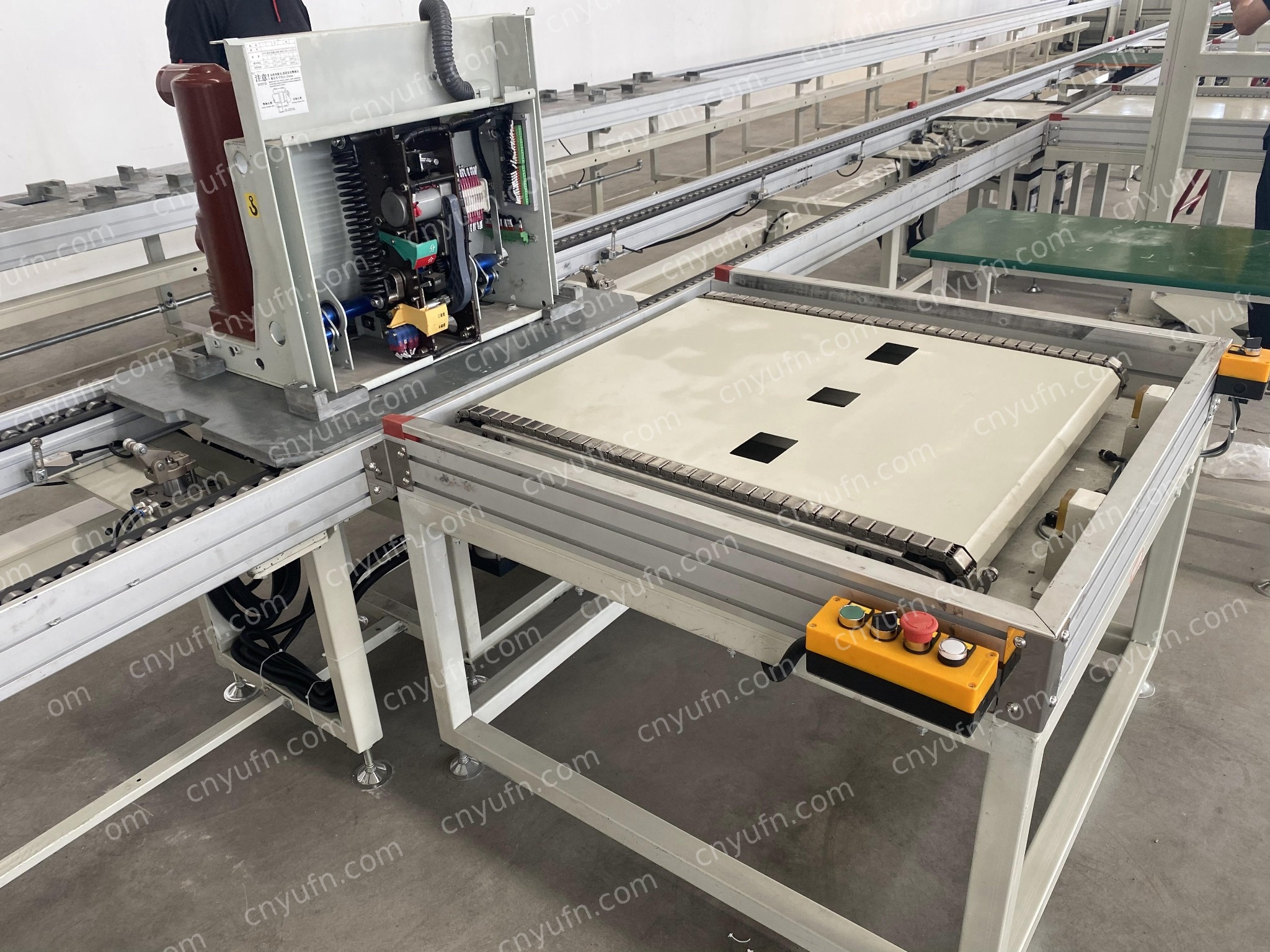
The layout of a production line determines logistics cost, space utilization and the position of bottlenecks. Many factories purchase equipment before planning the layout carefully, only to find long transfer routes, material build-up and queues at the test area after the equipment arrives. At Taizhou Yufeng Intelligent Equipment Co., Ltd., we use layout simulation and material flow analysis in the design phase to decide the station sequence, transfer method and buffer areas before configuring any equipment.
The role of RGV transfer in a VCB line
An RGV, or rail-guided vehicle, is suitable for moving products along a fixed track at a fixed cycle. It fits medium-voltage circuit breakers well because the products are large, heavy and must flow through stations in a defined order. We usually place the RGV track in the middle of the line with assembly stations on both sides. When a product finishes one station, the RGV moves it automatically to the next. Compared with forklifts and manual handling, RGV transfer gives accurate positioning and controllable cycle time, and it can work with automatic docking devices at each station to reduce manual loading and unloading.
Arranging the inspection benches
Mechanical characteristic test benches and withstand voltage test equipment have highly variable processing times, so buffering is essential. Our approach is to set buffer positions in front of the test area. The assembly area completes the next unit in advance, so the test station keeps running without idle waiting. Safe spacing is kept between test benches, and the high-voltage test zone is isolated with guards and warning signs. Test data is recorded into the database through the local industrial PC and linked with the scan-code information from the assembly stations, creating a complete product history.
The value of station-based assembly
Station-based assembly divides a complete breaker into standard work units. Each station performs only a few actions, and the work instruction defines every step. The benefits are clear quality responsibility, short operator training time and stable process content. For a product like a VCB with high assembly precision, stations also allow pneumatic pressing, torque control and vision mistake-proofing at key points to reduce missing and wrong parts.
Expansion and flexibility
The layout reserves track extension positions and new station interfaces for future capacity growth. If the customer later plans to add automatic handling robots or expand the test scope, the line can be upgraded gradually without stopping production. For flexibility, pallets and fixtures use quick-change structures, and changeover time is controlled within 30 minutes.
Planning advice
We recommend that customers provide the factory floor plan, product list, daily output, test standard and current logistics method during the planning stage. The more complete this information is, the more practical the layout becomes. We can also provide a 3D layout proposal and cycle time explanation before finalizing the equipment list.
Taizhou Yufeng specializes in automated assembly lines, custom equipment and turnkey integration, and can provide VCB line layout design, RGV transfer systems, inspection benches and custom equipment manufacturing. Contact us for a project evaluation.